
Velella, a.k.a. the by-the-wind sailor, a.k.a. Velella velella. A tiny inflatable raft (it comes equipped with an internal chitinous air chamber) with a sail. Usually about 7 cm across — the smallest seaworthy vessel on the planet. A colonial hydrozoan.
These little sailors are distant relatives of jellyfish and corals. They race across the open ocean at the mercy of waves and wind, trailing short tentacles beneath them and using those to snatch up anything that can fit into their tiny but predatory mouths, from krill to fish fry.
The colony unites three types of organisms.
The gastrozooid is the biggest, and there is only one per colony; without it the whole enterprise collapses — it is the only one capable of catching food. And, naturally, the one doing the eating. Still, it shares with the surrounding gastrogonozooids. Those take the food straight from its mouth; they cannot catch anything themselves, only dine. But in return they secure not merely the colony’s day-to-day survival, but its grand future as well: they are responsible for reproduction. And this entire culinary-erotic debauchery is guarded by grim warriors — the dactylozooids. They do not even possess mouths, only malicious stinging cells; the comrades they protect feed them pre-digested meals.

The reproductive habits of these sailors are no less baroque. Looking at the gonozooids of an adult velella, one is tempted to say that they are the most privileged members of the colony — they do nothing but gorge on what others have caught and have sex. But the latter would not be accurate: gonozooids are strangers to carnal amusements. Entirely asexual, they bud off from themselves tiny, perfectly individual medusoids, free-swimming little jellyfish entirely devoid of their parents’ colonial instincts.
And it is these minuscule dioecious medusoids that go in search of great heterosexual love. For this they descend to depths of a kilometer, find partners there (I truly cannot imagine how), and spawn. From the fertilized eggs emerge planulae — tiny ship-larvae. They are plump, light, and quickly float back to the surface. There, each planula transforms into the first polyp of a new colony, and from that pioneer, by budding without separation, all the remaining polyps are produced. So everyone in the colony is a band of little colonial brothers — sibling clones.
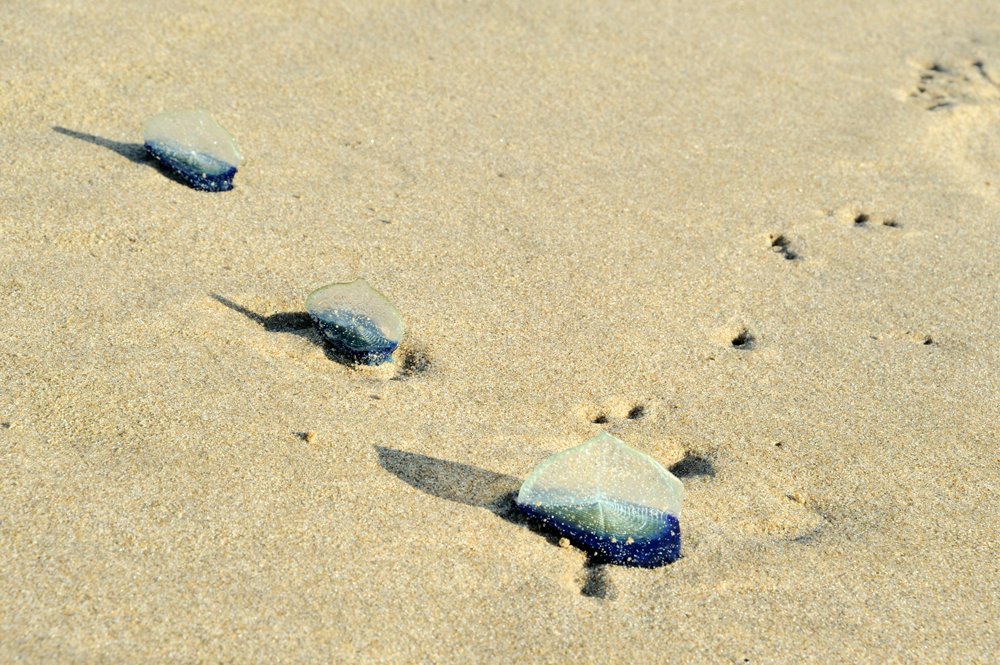
By-the-wind sailors are famous cosmopolitans, but they are no lovers of cold and prefer the tropics and subtropics (I have just gone to inspect myself in the mirror — am I perhaps a colonial hydrozoan?). Yet when one drifts across the world ocean without a rudder and with a single sail, shipwreck is practically the inevitable end of life. On our western coast, beaches carpeted with the aftermath of such mass wrecks are an annual spring-and-summer occurrence.

The beaches of Oregon — last July.

